How to choose an injectables treatment safely

Drs. Tom van Eijk
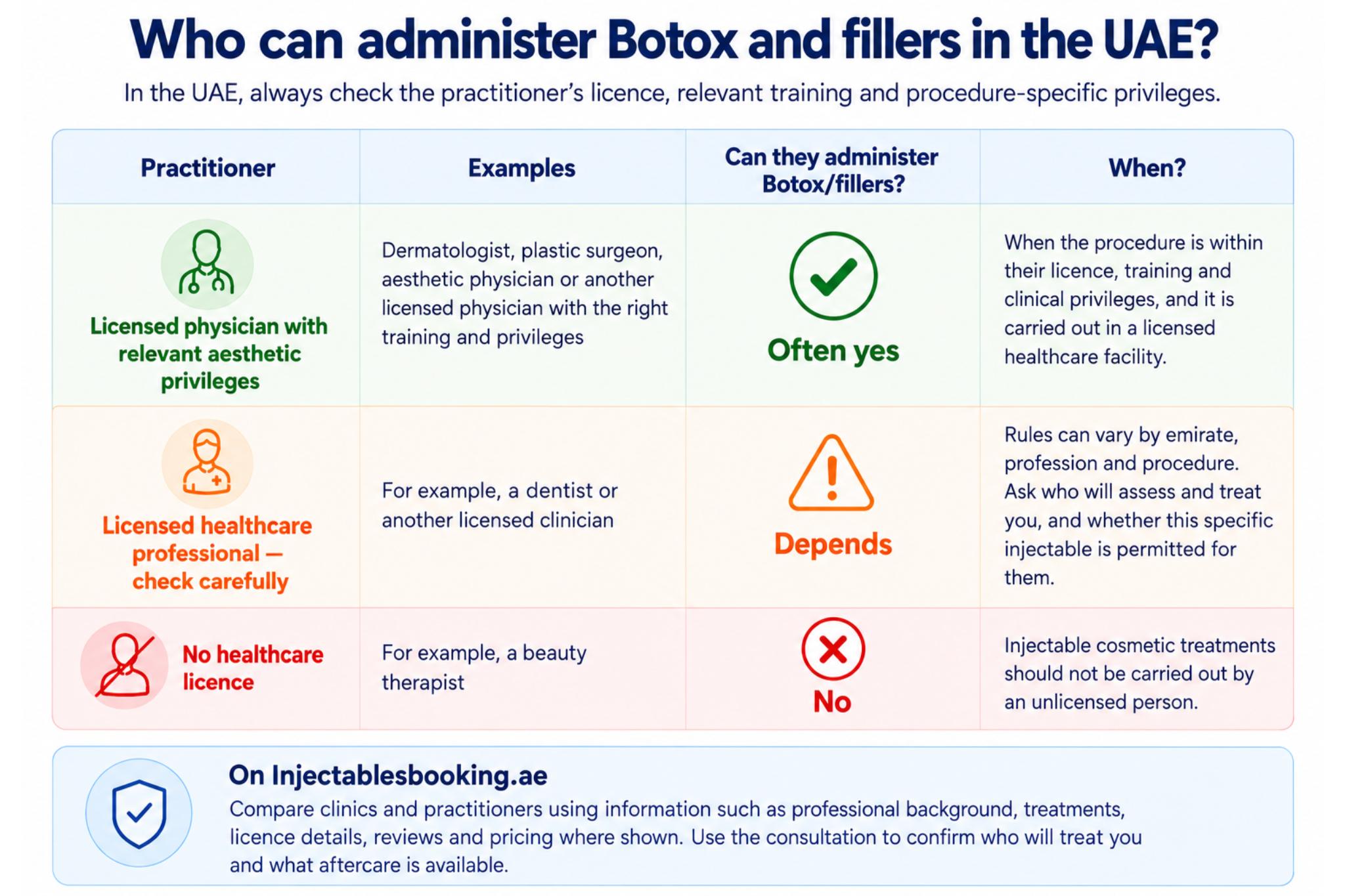
Choosing an injectables treatment safely starts with checking who will treat you, whether they are appropriately licensed for their role and whether they have relevant experience with the procedure you are considering.
A healthcare licence is an important first check, but it is not the only one. Depending on the emirate, treatment and practitioner's professional title, additional training, scope-of-practice requirements or clinical privileges may apply.
Before deciding, check the practitioner, clinic, consultation process, treatment plan and aftercare arrangements.
For a detailed explanation of practitioner roles, see who can administer Botox and fillers in the UAE.
6 checks before having injectables in the UAE
- 1 Confirm who will perform the treatment
- 2 Verify the practitioner's licence
- 3 Check treatment-specific experience
- 4 Assess the consultation
- 5 Check the clinic and treatment setting
- 6 Confirm aftercare and complication support
Confirm exactly who will perform your treatment
Before booking, find out the full name and professional role of the person who will actually perform the injections.
Do not assume that the doctor shown in an advertisement, on social media or on the clinic homepage will necessarily be your treating practitioner.
Ask:
Who will assess me?
Who will perform the injections?
What is their professional title?
Which health authority licenses them?
Are they authorised or privileged for this specific procedure?
The answer should be clear before you agree to treatment.
Verify the practitioner's UAE licence
Healthcare practitioners in the UAE practise under the relevant health authority for their jurisdiction. Depending on where the clinic is located, this may include authorities such as the Dubai Health Authority (DHA), Department of Health – Abu Dhabi (DOH), or Ministry of Health and Prevention (MOHAP).
Check that the practitioner's licence is current and matches their stated professional title.
In Dubai, you can also find licensed professionals through the Dubai Medical Registry. A licence alone, however, should not be treated as proof that someone may perform every cosmetic procedure. Specific clinical privileges and scope-of-practice requirements can apply.
A licence is not the same as permission for every injectable procedure
This distinction is especially important in the UAE.
A practitioner may hold a valid healthcare licence but still need the appropriate training, professional scope and clinical privilege for the procedure being considered.
For example, current Dubai standards distinguish between different practitioner categories and different non-surgical cosmetic procedures. The permissions for facial botulinum toxin, facial fillers, nose treatments and injections in other body areas are not identical.
Abu Dhabi similarly uses procedure-specific requirements based on professional category, training and clinical privileges.
This means that the most useful question is not simply:
“Are you licensed?”
It is also:
“Are you licensed and appropriately privileged to perform this specific treatment?”
Check experience with the exact treatment you want
Experience with injectables in general does not automatically mean equal experience with every product or anatomical area.
Ask how regularly the practitioner performs the treatment you are considering.
Useful questions include:
How often do you perform this procedure?
How much experience do you have with this treatment area?
What specific training have you completed?
What are the limitations of the treatment?
Which complications can occur?
How would you manage a complication?
When would you advise a patient not to proceed?
A practitioner who regularly performs lip fillers, for example, may not necessarily have the same experience with nose fillers, tear trough treatments or other higher-complexity areas.
There is no single number of treatments that proves someone is suitable. Look for relevant training, current experience and familiarity with the exact treatment and anatomical area.
Use the consultation to assess the practitioner
A consultation should give you enough information to decide whether you want to proceed.
The practitioner should ask about relevant aspects of your medical history, medicines, allergies, previous cosmetic treatments and what you would like to achieve.
You should also receive a clear explanation of:
the proposed treatment;
what it may realistically achieve;
what it cannot guarantee;
possible side effects and complications;
the product or medicine being used where relevant;
alternative options where appropriate;
the total price;
aftercare;
and what happens if you develop a concern.
You should be able to ask questions and decide not to proceed if the treatment does not feel appropriate for you.
Check the clinic as well as the practitioner
The person performing the treatment matters, but so does the environment in which it takes place.
Before proceeding, check that you are attending an appropriately licensed healthcare facility and that the treatment is being provided within the clinic's permitted services.
The clinic should also have clear processes for:
patient assessment;
infection control;
medicines and product management;
informed consent;
emergency response;
clinical records;
complications;
and patient complaints.
A polished reception area or strong social media presence does not replace these healthcare requirements.
Other checks before treatment
Should I ask which product will be used?
Yes. Ask what product or medicine is planned and why it has been selected for your treatment. The practitioner should be able to explain what is being used and discuss relevant risks and expected effects.
Are reviews enough to choose a clinic?
No. Reviews can provide useful information about other patients' experiences with communication, service and aftercare, but they do not prove that a practitioner is appropriately licensed or experienced with your specific treatment.
Should price determine which clinic I choose?
Price can be compared, but it should not be the only factor. Consider the practitioner's licence, treatment-specific experience, consultation, treatment setting and aftercare alongside the cost.
Do before-and-after photos prove experience?
Photos may help you understand the type of work a practitioner presents, but they do not verify licensing or guarantee that you will achieve the same result.
Check the aftercare plan before treatment
You should know what support is available before the injections are performed.
Ask:
Who should I contact if I have a concern?
Is follow-up available?
Who assesses possible complications?
How can I contact the clinic outside normal opening hours?
What should I do if my symptoms are unexpected?
Is the treating practitioner available for follow-up?
The exact warning signs vary between treatments, so the practitioner should explain what is relevant to your procedure.
Good aftercare does not make an injectable treatment risk-free. It gives you a clear route for advice and assessment if something does not develop as expected.
Warning signs before an injectables treatment
Consider pausing and asking more questions if:
you cannot identify the person who will perform the injections;
the practitioner's licence cannot be verified;
their professional role is unclear;
they cannot explain whether they are authorised for the treatment;
relevant treatment experience is unclear;
there is no proper consultation;
risks or possible complications are dismissed;
the product being used is not explained;
you feel pressured to proceed immediately;
treatment is being offered in an inappropriate setting;
there is no clear aftercare contact;
or a specific result is guaranteed.
One concern does not automatically establish that a practitioner or clinic is unsafe. It is a reason to obtain more information before deciding.
How Injectablesbooking can help you compare
Injectablesbooking.ae brings clinic and practitioner information together so you can compare available options before deciding whether to arrange a consultation.
Depending on the profile, you may be able to compare information such as:
practitioner name and professional role;
DHA, DOH or MOHAP licence information;
clinic location;
treatments offered;
relevant experience;
patient reviews;
and available prices.
Use the profile as a starting point, then confirm important details during your consultation.
You can also read our guide to choosing a cosmetic doctor in the UAE.
Compare injectables clinics in the UAE
Compare on experience & price Make an appointment immediately
Frequently asked questions about choosing injectables safely
How do I check whether an injectables practitioner is licensed in the UAE?
Ask which health authority licenses the practitioner and verify their current professional details with the relevant authority. Depending on the location, this may include DHA, DOH or MOHAP.
Does a UAE medical licence mean someone can perform every injectable treatment?
No. A valid professional licence does not automatically give permission for every cosmetic procedure. Scope of practice, training and clinical privileges can also apply.
What should I ask an injectables practitioner before treatment?
Ask about their licence, relevant training, experience with your specific treatment, expected outcome, risks, product used, price, aftercare and how complications are managed.
How important is treatment-specific experience?
It is important because experience can vary between injectable products, procedures and anatomical areas. Ask about the exact treatment you are considering.
Should I check the clinic's licence too?
Yes. Injectable cosmetic treatments should be performed within an appropriately licensed healthcare setting that is permitted to provide the relevant service.
Are patient reviews enough to choose a practitioner?
No. Reviews provide context about other patients' experiences but should be considered alongside licensing, relevant training, treatment experience, consultation and aftercare.
Should price be the main factor when choosing a clinic?
No. Compare price together with the practitioner's qualifications, relevant experience, treatment plan, clinic setting and aftercare.
Can I decide not to proceed after the consultation?
Yes. A consultation should help you understand the proposed treatment and its risks and limitations so you can make your own decision about whether to proceed.