CO2 Laser

Drs. Tom van Eijk
Fractional CO2 laser is an ablative skin-resurfacing treatment that creates controlled microscopic treatment zones in the skin. It may be used to improve selected acne scars, fine lines, uneven texture and some visible signs of sun-related skin ageing.
The treatment works differently from a superficial facial or non-ablative laser. CO2 laser removes very small areas of tissue while generating controlled heat within the treated skin. This triggers healing and collagen remodelling over the following weeks and months.
With fractional CO2 resurfacing, the entire skin surface is not treated continuously. Microscopic treatment zones are separated by areas of untreated skin, which play a role in the healing process.
Treatment intensity can vary considerably. Your skin type, skin tone, treatment area, indication, laser settings and individual healing response can all affect the result and recovery.
Fractional CO2 laser cannot guarantee scar removal, wrinkle removal or perfectly even skin. A consultation is needed to establish what level of improvement may realistically be possible.
Fractional CO2 laser at a glance
Treatment type: Fractional ablative laser resurfacing
Main purpose: Improve selected skin texture concerns through controlled resurfacing
May be considered for: Certain acne scars, fine lines, uneven texture and photodamage
Result: Develops progressively after the skin heals
Number of sessions: Depends on the indication and treatment intensity
Downtime: Varies significantly according to the treatment settings and area
Long-term result: Variable rather than permanent
Important factor: Appropriate settings for the individual skin type and indication
There is no single standard CO2 laser protocol. Two clinics may both offer “fractional CO2 laser” while proposing different treatment intensities, devices and recovery periods.
How does fractional CO2 laser work?
A CO2 laser produces light at a wavelength that is strongly absorbed by water in skin tissue. The energy can therefore create highly controlled microscopic areas of ablation and thermal effect.
With fractional treatment, the laser creates multiple small columns or microzones rather than resurfacing every part of the skin continuously.
The surrounding untreated areas contribute to the healing process. During recovery, damaged tissue is repaired and collagen undergoes gradual remodelling.
This is why the appearance of the skin can continue changing after the visible initial healing period has finished.
What can the practitioner adjust?
Depending on the device, the treatment plan can involve adjustments to:
energy;
treatment density;
depth;
pulse characteristics;
number of passes;
size of the treatment area.
A stronger setting is not automatically a better setting. Increasing treatment intensity can also increase inflammation, downtime and the risk of unwanted pigment changes or other complications.
How does a fractional CO2 laser treatment usually work?
- 1 Consultation and skin assessment
- 2 Review of skin tone, medical history and treatment goal
- 3 Selection of treatment area and laser parameters
- 4 Skin preparation and anaesthesia where appropriate
- 5 Fractional laser treatment
- 6 Immediate aftercare instructions
- 7 Follow-up depending on healing and treatment intensity
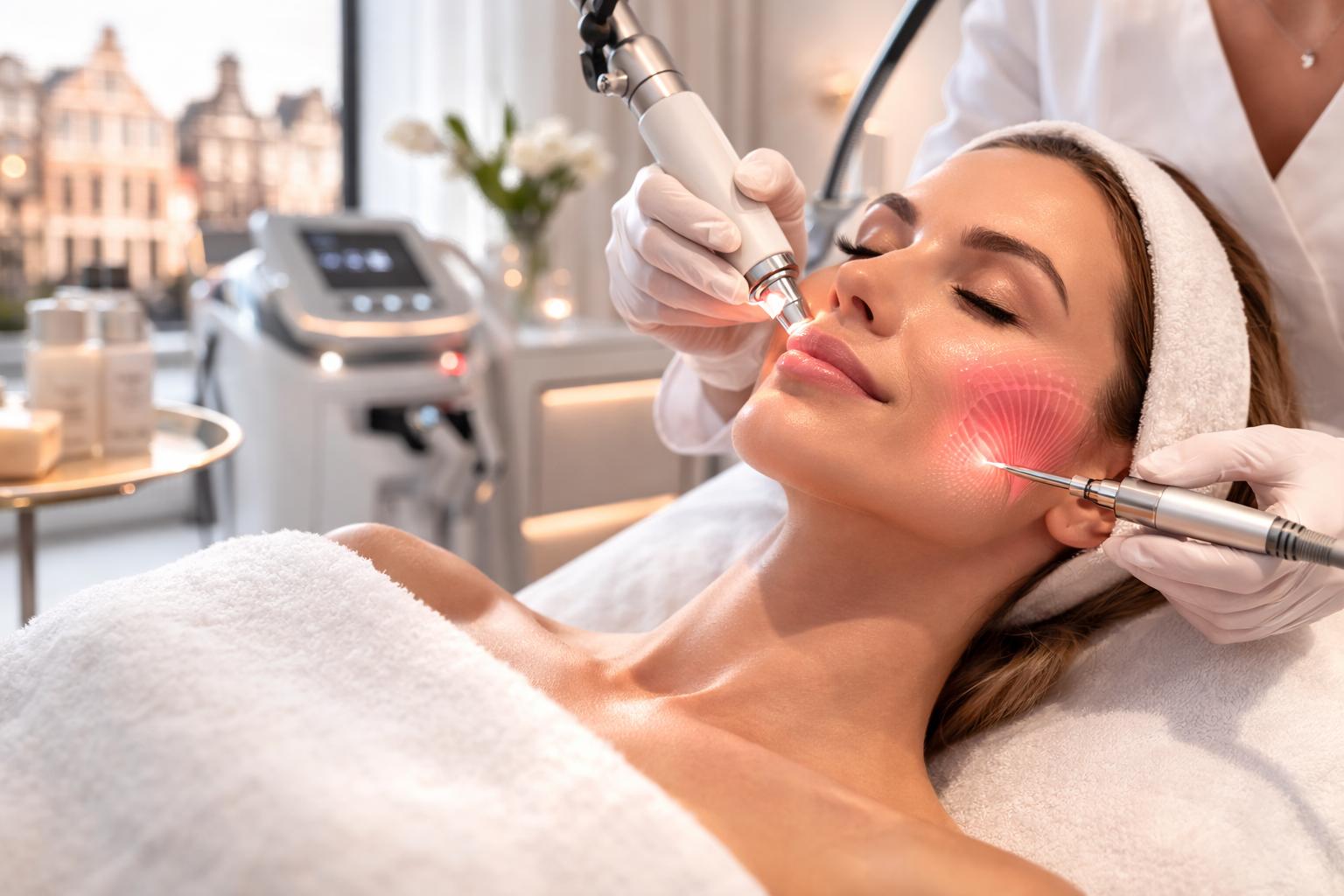
What can fractional CO2 laser be used for?
Fractional CO2 laser is mainly a skin-resurfacing treatment. It does not add facial volume and is not designed to change facial proportions.
Depending on the skin assessment and treatment parameters, it may be considered for:
selected acne scars;
certain other textural scars;
fine lines;
rough or uneven skin texture;
enlarged-looking pores;
selected signs of sun damage or photoageing.
The expected response depends on the concern being treated. A deep acne scar, for example, should not be expected to respond in the same way as superficial textural irregularity.
Which areas can be treated?
The face is a common treatment area.
Other areas may sometimes be treated, but skin thickness and healing characteristics vary across the body. Settings suitable for one area should therefore not automatically be applied to another.
Areas such as the neck require particularly careful treatment planning because their healing characteristics differ from those of facial skin.
VA notes:
What results can you expect from fractional CO2 laser?
After the initial healing period, the treated skin may appear smoother and some textural irregularities may become less noticeable.
Results are not immediately final. Collagen remodelling and skin repair continue after the surface has healed, so changes can develop gradually over the following weeks and months.
Why do results differ between people?
Results can depend on:
the concern being treated;
depth and type of scarring;
skin tone and phototype;
skin thickness;
amount of sun-related damage;
laser parameters;
treatment density;
individual healing response;
number of sessions.
A before-and-after photograph from another patient therefore cannot predict your own result.
How many sessions are needed?
There is no universal number of fractional CO2 laser sessions.
Some treatment plans may use a more intensive session with greater downtime. Others may use several treatments spaced apart.
The appropriate approach depends on the indication, skin characteristics, previous treatments, acceptable downtime and the practitioner's assessment.
How long do fractional CO2 laser results last?
Fractional CO2 resurfacing can produce changes that remain visible after the treatment has healed, but the result does not have one fixed duration.
How long an improvement remains noticeable depends on factors such as:
the original skin concern;
treatment intensity;
individual collagen response;
ongoing skin ageing;
subsequent sun exposure;
skincare and other treatments.
The treatment does not stop normal skin ageing or prevent future sun-related changes.
For that reason, “long-lasting but variable” is more accurate than promising that every result will last a set number of years.
What is recovery like after fractional CO2 laser?
Fractional CO2 laser deliberately creates a controlled skin injury, so visible recovery should be expected.
During the early healing period, you may experience:
redness;
swelling;
warmth or a burning sensation;
tightness;
peeling;
crusting or small scabs depending on the treatment intensity.
The most visible phase may last several days, but this varies considerably. Redness can remain after the surface has otherwise healed, particularly after a stronger treatment.
A deeper or denser treatment generally involves more recovery than a lighter protocol.
Why does treatment timing matter in the UAE?
Sun exposure is an important consideration before and after laser resurfacing. A tan or sunburn can affect whether laser treatment should proceed, while UV exposure during recovery can increase the risk of unwanted pigment changes.
If you spend significant time outdoors, travel frequently or have upcoming beach or outdoor activities, discuss this when planning the timing of your treatment.
Fractional CO2 laser aftercare
Your clinic should provide aftercare that matches the device, treatment intensity and your skin.
Typical instructions may address:
how to cleanse the treated skin;
which moisturising or barrier products to use;
when makeup can be restarted;
which active skincare products should temporarily be avoided;
whether crusting should be left untouched;
how to protect the skin from sunlight;
when sunscreen can safely be restarted;
when to contact the clinic.
Do not peel, scratch or deliberately remove crusts unless your clinician has specifically instructed you to do so.
Once your clinician advises that sunscreen can be applied again, consistent broad-spectrum sun protection is particularly important.
Fractional CO2 laser side effects and risks
What reactions are expected after fractional CO2 laser?
Redness, swelling, warmth, tightness, peeling and crusting can occur as part of the healing response. How noticeable these reactions are depends on the treatment intensity, area and individual skin response.
Can fractional CO2 laser cause hyperpigmentation?
Yes. Post-inflammatory hyperpigmentation can occur after laser treatment, particularly in skin that is more prone to pigment changes. Sun exposure during the healing period can also increase pigmentation risk.
Can the treated skin become lighter?
Hypopigmentation, or loss of pigment, is another possible pigment change after resurfacing. It is less common but may be persistent in some cases.
Can infection or scarring occur?
Infection and abnormal scarring are recognised complications of laser resurfacing. They are different from expected temporary redness or swelling and require appropriate clinical assessment.
When should you contact the clinic?
Contact the clinic if pain or swelling becomes unexpectedly worse, healing appears to deteriorate rather than improve, or you develop symptoms that could indicate infection, abnormal pigmentation or another unexpected reaction.
Fractional CO2 laser and different skin tones in the UAE
Skin tone is particularly important when planning ablative laser resurfacing.
People with darker skin tones can be more susceptible to post-inflammatory hyperpigmentation and other pigment changes after laser procedures. This does not automatically mean that fractional CO2 laser can never be considered, but it makes individual assessment, appropriate settings and experience with the relevant skin type especially important.
The UAE has a highly diverse patient population, so simply asking whether a clinic “offers CO2 laser” is not enough.
Ask how the practitioner evaluates:
your phototype;
previous pigmentation after inflammation or injury;
recent tanning or sun exposure;
existing pigmentation concerns;
previous laser reactions;
the treatment intensity planned for your skin.
A treatment protocol used for lighter skin should not automatically be copied to a darker phototype.
Who may need additional assessment before CO2 laser?
Fractional CO2 laser is not automatically suitable simply because someone has scars, fine lines or uneven texture.
A practitioner should review factors such as:
active skin infection or inflammation;
current tan or sunburn;
tendency towards abnormal scarring;
previous pigment changes after procedures;
medications and skincare that can affect healing or skin sensitivity;
history of cold sores where the treatment area is relevant;
previous laser treatments;
general health and healing history.
The purpose of this assessment is to determine whether CO2 resurfacing, different settings or another approach may be more appropriate.
How much does fractional CO2 laser cost in the UAE?
The price of fractional CO2 laser treatment in the UAE can vary because clinics may not be offering equivalent protocols.
Important price factors include:
treatment area;
size of the area;
treatment intensity;
device and protocol used;
time required;
anaesthesia where applicable;
number of sessions;
follow-up included in the treatment plan.
A lower listed price does not necessarily represent the same treatment as a higher one.
When comparing prices in AED, check exactly:
which area is included;
whether the treatment is fractional ablative CO2;
whether the price is per session;
whether consultation or anaesthesia is included;
whether follow-up is included.
Compare fractional CO2 laser clinics in the UAE
Compare on experience & price Make an appointment immediately
Fractional CO2 laser reviews: what should you look for?
Reviews can help you understand the patient experience around a clinic, but they do not prove that the treatment is medically appropriate for you or predict your result.
Useful details to look for include whether patients describe:
a clear consultation;
realistic explanation of downtime;
explanation of risks;
communication during recovery;
follow-up after treatment;
transparent pricing;
how questions or unexpected reactions were handled.
Be cautious about relying only on comments such as “amazing result” or “no downtime”. Treatment intensity and skin response can differ considerably between patients.
Fractional CO2 laser reviews
Special thanks as well to Ms. Emy for being so supportive during the session, she made me feel safe and reassured the whole time. I truly appreciate the whole team for being friendly, welcoming, and accommodating. Highly recommended! Show less »
I am so happy with everything she does, her botox is perfect as well fillers. I never look overdone and she is very professional. She’ll tell you straight away if you don’t need something.
I highly recommend her, she is amazing and my face and skin looks so much better! Show less »
Dr. Silvian explained in detail the tummy tuck and breast lift procedures and took the time to answer all my (many!) questions with patience and professionalism. The entire team is not only highly experienced and empathetic but also carries a great sense of humor that makes you feel at home and actually want to come back.
What I appreciated most is their focus on natural results. This is the only clinic I fully trust for major procedures because of their strong work ethic, sense of responsibility, and high level of care.
Beyond surgery, they also offer a wide range of advanced treatments for skin transformation—addressing pigmentation, redness, sagging, and more. With cutting-edge CO2 lasers and regenerative medicine, they focus on natural healing and modern technology to make aging feel optional.
Truly a clinic that combines expertise, innovation, and heart. Highly recommended! Show less »
Fractional CO2 laser compared with other skin treatments
Fractional CO2 laser is one of several approaches used for skin texture concerns.
Microneedling, chemical peels, non-ablative lasers and other resurfacing treatments work differently and involve different levels of skin injury, recovery and risk.
The useful question is therefore not simply which treatment is “strongest”.
A consultation should consider:
what concern is being treated;
how deep or severe it is;
your skin type and pigmentation risk;
expected downtime;
previous treatments;
the balance between potential improvement and recovery.
How to compare fractional CO2 laser clinics in the UAE
Not every clinic advertising “CO2 laser” offers the same device, settings, medical assessment or follow-up.
When comparing clinics, check:
which fractional CO2 device is used;
who performs or supervises the treatment;
whether the practitioner holds the appropriate licence for the location in which they practise;
the practitioner's experience with fractional ablative laser resurfacing;
experience treating your phototype;
how the clinic assesses pigmentation risk;
how laser parameters are selected;
what downtime is expected for the proposed settings;
what aftercare is provided;
what happens if you develop an unexpected reaction;
exactly what is included in the quoted price.
Which professional licence should you check?
Healthcare professional licensing in the UAE depends on the relevant health authority and where the professional practises.
For example, professionals practising in Dubai may be licensed through the Dubai Health Authority, while healthcare professionals in Abu Dhabi are regulated through the Department of Health – Abu Dhabi. Other locations may fall under another competent UAE health authority.
A licence confirms that the professional meets the applicable regulatory requirements for their registered role. It does not, on its own, prove extensive experience with fractional CO2 laser.
Ask specifically about experience with the treatment and with your skin type.
Compare clinics in United Arab Emirates

- Botox zone from
- د.إ 900,00
- Filler per ml from
- د.إ 900,00
- Profhilo per 2 ml from
- د.إ 900,00


- Botox zone from
- -
- Filler per ml from
- -
- Profhilo per 2 ml from
- -

- Botox zone from
- د.إ 800,00
- Filler per ml from
- د.إ 1800,00
- Profhilo per 2 ml from
- -


- Botox zone from
- -
- Filler per ml from
- -
- Profhilo per 2 ml from
- -
- Botox zone from
- -
- Filler per ml from
- -
- Profhilo per 2 ml from
- -
- Botox zone from
- -
- Filler per ml from
- -
- Profhilo per 2 ml from
- -
- Botox zone from
- د.إ 588,00
- Filler per ml from
- د.إ 1470,00
- Profhilo per 2 ml from
- -
- Botox zone from
- د.إ 500,00
- Filler per ml from
- د.إ 999,00
- Profhilo per 2 ml from
- -
Why can fractional CO2 laser treatments differ between UAE clinics?
Two clinics can advertise the same treatment name while delivering substantially different treatment plans.
Differences may include:
laser system;
treatment density;
energy;
depth;
pulse settings;
number of passes;
treatment area;
anaesthesia;
preparation;
aftercare;
follow-up.
This can change both the expected result and the recovery period.
For a meaningful comparison, ask each clinic what will actually be treated, what level of resurfacing is planned and what downtime is expected from those specific settings.
Frequently asked questions about fractional CO2 laser
What does your face look like after fractional CO2 laser?
The treated skin can initially look red and swollen and may feel warm or tight. Peeling, crusting or small scabs may develop depending on the intensity. The appearance changes progressively as the skin heals.
Is fractional CO2 laser effective?
Fractional CO2 laser can improve selected scars, fine lines and skin-texture concerns, but the amount of improvement varies. The indication, skin type, scar depth, settings and healing response all influence the result.
How long is the downtime after fractional CO2 laser?
Downtime varies according to treatment intensity and the area treated. The most visible healing usually occurs over several days, while redness can persist longer after more intensive resurfacing.
How many fractional CO2 laser sessions are needed?
There is no standard number. Some treatment plans use one more intensive session, while others involve several sessions. The appropriate plan depends on the concern, skin characteristics and acceptable downtime.
Can fractional CO2 laser remove acne scars completely?
No treatment can guarantee complete removal of acne scars. Fractional CO2 laser may make certain scars less noticeable by resurfacing the skin and stimulating remodelling, but the expected improvement depends on scar type and depth.
Is fractional CO2 laser suitable for darker skin?
It may be considered in selected cases, but darker skin tones can have a higher risk of post-inflammatory pigmentation after laser treatment. Careful skin assessment and appropriate settings are particularly important.
Can I have fractional CO2 laser if I have a tan?
Laser resurfacing should not automatically proceed on recently tanned or sunburned skin. Tell the clinic about recent sun exposure so the practitioner can decide whether treatment should be postponed.
Can I go in the sun after fractional CO2 laser?
Treated skin needs careful UV protection while it heals. Follow the clinic's instructions on sun avoidance and when to restart sunscreen, especially if you spend significant time outdoors in the UAE.
When will I see the final result?
Initial changes become easier to assess once the skin has healed, but collagen remodelling continues afterwards. The appearance can therefore continue developing over the following weeks and months.
How much does fractional CO2 laser cost in the UAE?
Prices vary according to the treatment area, intensity, number of sessions and what the clinic includes. Compare like-for-like treatment plans rather than the headline price alone.